Strategy

The Problem-Solving System That Top Consultants Use on Every Engagement

And why nobody taught it to the rest of us.

There is a system that the world’s top management consultants use to walk into any company, in any industry, facing any problem, and produce a clear, structured recommendation within weeks.

Not a vague strategy. Not a brainstormed list of ideas. A structured, defensible plan built on frameworks that have been tested across thousands of engagements over decades.

McKinsey uses it. BCG uses it. Bain uses it.

Companies pay these firms $500,000 or more for a single engagement. Not because their people are smarter than you. But because they have systems you have never been shown.

And that is the part that should bother you. The system itself is not a secret. It never was. It just never gets taught to the people who need it most.

Not in MBA programs (too theoretical). Not in business books (too bloated). Not in online courses (too shallow). And definitely not on the job, where you are expected to figure it out yourself.

So most professionals do what they can. They rely on experience. They improvise. They sit in high-stakes meetings and make recommendations based on gut instinct, hoping the logic holds up when someone pushes back.

It works. Until it doesn’t.

The gap that quietly stalls careers

Think about the last time you faced a serious business problem at work.

Maybe revenue was slipping and nobody could agree on why. Maybe you needed to present a strategy to leadership and were not sure your reasoning was airtight. Maybe your team was stuck, spinning on the same issue for weeks.

What did you do? If you are like most professionals, you did some research. You Googled. You pulled from past experience. You put something together that felt reasonable and hoped it would hold.

Sound familiar?
What senior leaders actually Google at 11pm
“how to present strategy to leadership”
Framing Problems with SCQA
Part 1
“root cause analysis template”
KPI Trees and Root Cause Analysis
Part 3
“how to prioritize projects with limited budget”
ICE Scoring, Weighted Scoring Models
Part 4
“framework for competitive analysis”
Porter’s Five Forces
Part 2
“how to structure a business problem”
MECE Principle
Part 1
“how top consultants solve problems”
The 6-Step Problem-Solving Process
Part 1

That is not a system. That is survival mode. And it is exactly where most careers quietly stall.

Without a system
Vague problem
“Something feels off”
Google and guess
Scattered tabs, conflicting advice
Improvise a solution
Hope the logic holds up
Present with doubt
“I think we should…”
Outcome: uncertain
Low confidence, high stress
With a system
Define with SCQA
Frame the real problem
Break down with MECE
No gaps, no overlaps
Analyze with frameworks
SWOT, Porter’s, KPI trees
Prioritize with ICE
Score options, pick the best
Outcome: structured
Clear plan, high confidence

The gap between “smart professional who works hard” and “the person in the room everyone trusts to solve problems” almost never comes down to intelligence or effort. It comes down to whether you have a repeatable process for breaking things down, analyzing what is actually happening, and building solutions that hold up under scrutiny.

Consultants have that process. Most of the business world doesn’t. Not because it is hidden, but because nobody ever organized it into something usable.

Your ability to deliver as problems get harder
Output quality as problem complexity increases
Without a system With a system Routine decisions High-stakes strategy PROBLEM COMPLEXITY Low High OUTPUT QUALITY
Be honest with yourself
The meeting you are replaying right now
Someone challenged your logic in front of the room and you couldn’t explain your reasoning clearly.
SCQA framing Part 1: Foundations
SCQA forces you to structure any recommendation into Situation, Complication, Question, Answer. When someone pushes back, you don’t scramble. You walk them through the logic.
A colleague half your age presented a strategy that sounded sharper than yours.
The 6-Step Problem-Solving Process Part 1: Foundations
They didn’t know more than you. They had a structure. The 6-step process gives you the same backbone so your experience actually shows up in how you communicate.
Someone mentioned a framework you’d never heard of, and you just nodded along.
All frameworks, all in one place Parts 1–7
MECE, Ansoff, BCG, ICE, Kaizen, PESTLE, Porter’s. Every framework a consultant would know, illustrated and explained. No more pretending.
You had the right answer, but couldn’t back it up with anything beyond gut feeling.
Hypothesis-Driven Testing + Decision Frameworks Part 4: Crafting Solutions
Your instinct was right. You just didn’t have the structure to prove it. Hypothesis testing and decision matrices turn gut feeling into a defensible case.

What the system actually looks like

The consulting problem-solving methodology follows a clear sequence. Every engagement, every problem, every industry. The same structure.

The same process top firms use on every engagement. From Consulting Management EXPLAINED.

It starts with defining the problem correctly. This sounds obvious, but it is where most teams fail. They jump to solutions before they even agree on what they are solving. Consultants use a framework called SCQA (Situation, Complication, Question, Answer) to force clarity before any analysis begins.

One of over 40 illustrated frameworks inside the book.

Once the problem is framed, they break it apart using a logic structure called MECE (Mutually Exclusive, Collectively Exhaustive). Every component is separated cleanly. No overlaps. No gaps.

Each framework is illustrated with professional, consultant-grade diagrams.

From there, the toolkit branches depending on what the problem demands.

Need to understand the competitive landscape? Michael Porter’s Five Forces maps exactly where profit pressure is coming from, who holds the power, and where the openings are.

Need to prioritize which ideas to pursue with limited resources? ICE Scoring (Impact, Confidence, Ease) gives you a weighted system for ranking options.

LIMITED-TIME OFFER

LOWEST PRICE EVER: Consulting Management EXPLAINED is currently at its lowest price in history. Lock in 40% OFF before the price goes back up.

Get it now at the lowest price we’ve ever offered

NOTE: This price is only available on our website – not on Amazon or anywhere else.
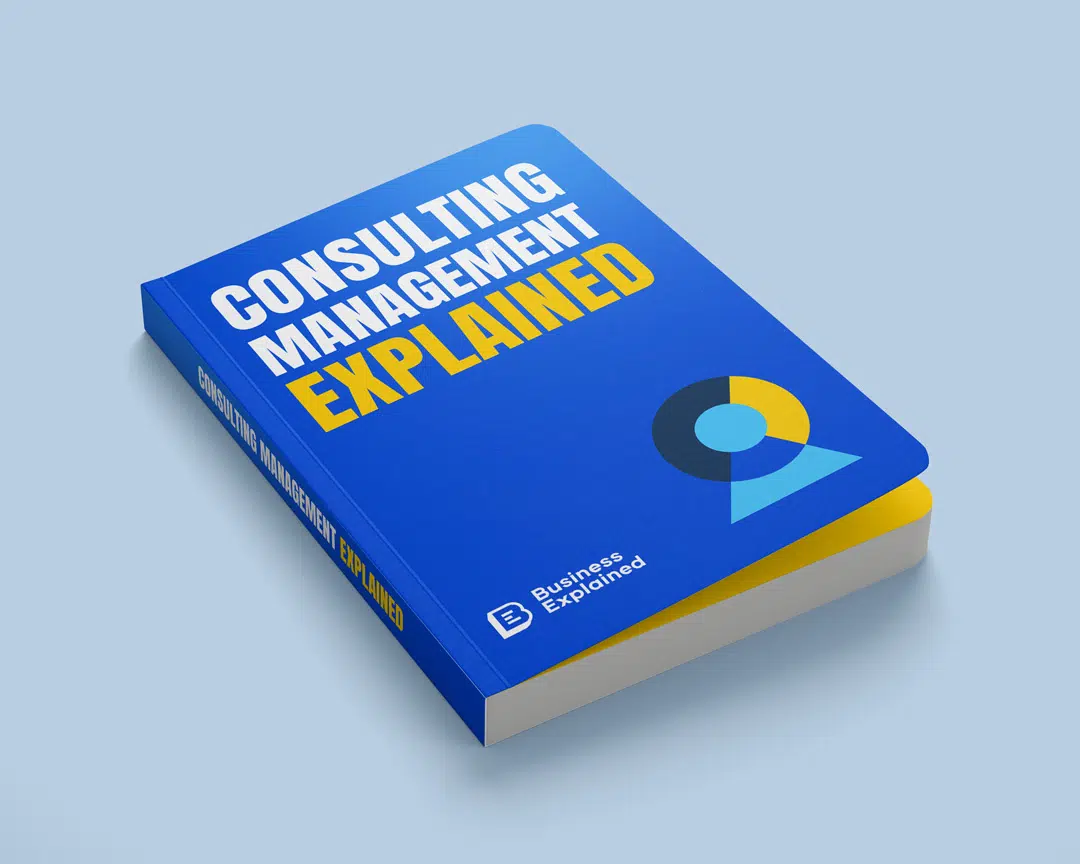
Consulting Management EXPLAINED
★★★★★ 4.93 (80,000+ served)
40+ FRAMEWORKS ILLUSTRATED INSTANT PDF 109 PAGES
GET 40% OFF NOW!
🔒 Secure Checkout 📧 Instant Delivery 💰 30-Day Money Back
The quiet ones
The questions you don’t ask out loud
“Am I the only senior person who doesn’t know what MECE means?”
Critical Thinking and the MECE Principle Part 1
“Should I know Porter’s Five Forces by now?”
Porter’s Five Forces for Competitive Dynamics Part 2
“How do consultants always sound so structured?”
The 6-Step Problem-Solving Process Part 1
“What’s the difference between KPIs and OKRs? I should know this.”
Tracking Performance with KPIs and OKRs Part 6
“How do I actually present a strategy without rambling?”
Framing Problems with SCQA Part 1
“Everyone talks about Agile. I still don’t fully get it.”
Project Management Methods (Agile, Scrum, Kanban) Part 6

Need to execute and actually deliver results? The system covers Agile, Scrum, Kanban, Gantt, Kaizen, Lean, and Six Sigma. Not as buzzwords you hear in meetings, but as structured methodologies with clear rules, roles, and implementation steps.

Execution frameworks covered in the book
Agile · Iterative delivery in short cycles
Scrum · Sprint-based team execution with defined roles
Kanban · Visual workflow and capacity management
Gantt · Timeline-based project scheduling
Kaizen · Continuous small improvements, compounding over time
Lean · Eliminate waste, maximize value delivery
Six Sigma · Data-driven defect reduction (DMAIC)
OKRs · Align teams around measurable outcomes

This is not theory. It is an operating manual for thinking clearly, making decisions under pressure, and building recommendations that nobody can poke holes in.

The Monday morning test
5 real problems. What would you open?
1
Your CEO asks you to cut 20% from the budget by Friday.
Cost Analysis + 80/20 Rule Part 3: Breaking Down Problems
Open the cost analysis chapter. Map all spend categories, apply 80/20 to find the 20% of costs driving 80% of waste, and present a structured cut plan instead of slashing blindly.
2
Two departments are blaming each other for a missed target.
Root Cause Analysis + KPI Trees Part 3: Breaking Down Problems
Use the KPI tree to trace the missed target down to its actual drivers. Root cause analysis removes the politics and shows exactly where the breakdown happened.
3
You need to present a growth strategy to the board next Tuesday.
SCQA + Ansoff Matrix Part 1 + Part 4
Frame the presentation with SCQA so the narrative is airtight. Use Ansoff to map your growth options across markets and products. Walk in with a structure no one can poke holes in.
4
Leadership wants to enter a new market but nobody agrees on which one.
Porter’s Five Forces + Market Sizing (TAM/SAM/SOM) Part 2: Analyzing the Environment
Run Five Forces on each candidate market to see where profit pressure is lowest. Size each opportunity with TAM/SAM/SOM. Turn opinion into data.
5
A product line is underperforming and you need to decide: fix, pivot, or kill.
BCG Matrix + ICE Scoring Part 4: Crafting Solutions
Plot the product on the BCG Matrix to see if it is a Dog, Cash Cow, Star, or Question Mark. Then ICE score your options (fix/pivot/kill) to make the call defensible.
Real outcomes
What happens when you actually use the frameworks
40 min
From stuck to approved
SCQA
I used the SCQA framework to restructure a product launch presentation that had been stuck in revisions for two weeks. Reframed the entire pitch in 40 minutes. The board approved it the same day.
$340K
Recovered annually
Porter’s Five Forces
Ran a Five Forces analysis on three markets we were considering entering. Discovered that supplier concentration, not competition, was the real threat to our margins. We renegotiated three contracts and recovered $340K annually.
42 → 3
Ideas to action in one session
ICE Scoring
My team had 40+ ideas after a strategy offsite and no way to choose. Used ICE Scoring to rank them in one session. We cut the list to 3 pilots. Two delivered measurable results within the first quarter.
Based on outcomes reported by professionals using frameworks from the book.

Why this matters right now

The margin for slow or unfocused decision-making is shrinking fast. Markets shift quarterly. AI is reshaping entire industries. Budgets are tighter, teams are leaner, and leaders are expected to move faster with less room for error.

In this environment, the professionals who get promoted, win projects, and earn trust are not always the ones with the most experience. They are the ones who bring structure to chaos.

That is not a personality trait. It is a skill. And it is built entirely on frameworks.

109 pages. One complete system.

Everything described above has been compiled into a single resource called Consulting Management EXPLAINED.

It covers the full consulting problem-solving methodology from start to finish:

The complete system
1
Foundations
MECE, SCQA, 6-step process
How to think like a consultant
2
Environment analysis
SWOT, PESTLE, Porter’s, TAM
Read the market and competition
3
Problem breakdown
KPI trees, 80/20, root cause
Diagnose what is actually wrong
4
Solution design
Ansoff, BCG, ICE scoring
Build and test your recommendation
5
Strategy and growth
Pricing, scaling, innovation
Plan for long-term advantage
6
Implementation
Agile, Scrum, Kanban, OKRs
Execute and track results
7
The toolkit
Checklists, templates, walkthroughs
Apply it to any problem, today

Every concept is illustrated with professional diagrams and visual breakdowns. Not decorative graphics. The kind of functional visuals a senior consultant would put in front of a client.

You can start at any chapter, learn one framework completely, and apply it at work the same day.

This is not another surface-level business book

Most business books take one idea and stretch it across 300 pages of anecdotes. This is the opposite. 109 pages packed with frameworks, each one broken down, illustrated, and ready to use.

It is the difference between reading about strategy and actually having the tools to do strategy.

What actually changes
Without a system
With the book
Solving a new business problem
Days of research
Open the right chapter
Presenting to leadership
Gut feeling + slides
Structured SCQA framework
Diagnosing performance issues
Guessing at causes
KPI trees + root cause analysis
Prioritizing initiatives
Loudest voice wins
ICE scoring, weighted models
Running team execution
Ad hoc check-ins
Agile, Scrum, or Kanban system
Confidence in your recommendation
Hope it holds up
Backed by proven frameworks
How it compares
This
Book
MBA
Programs
Online
Courses
Business
Books
Free
Content
Visual frameworks and diagrams
Actionable the same day
Covers full consulting toolkit
Concise (no filler)
Standalone chapters
Consultant-grade depth
Structured and organized
Affordable

Consulting Management EXPLAINED is the top-selling title from Business Explained, a catalog of 45+ business eBooks rated 4.93 out of 5.
4.93/5
Average rating
80,000+
Professionals served
190+
Countries
<0.4%
Refund rate

Fewer than 4 in every 1,000 buyers ask for their money back.
That number tells you more than any testimonial ever could.
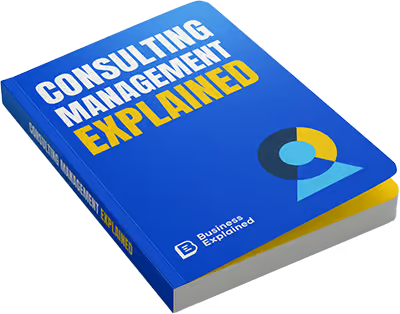
Consulting Management Explained
4th of July Sale – 40% off

If you have ever walked into a meeting without a framework, you know why this exists.

Every professional hits the same wall eventually. The problems get bigger. The stakes get higher. And the “figure it out as you go” approach stops working. This book is for the moment you decide you want a system instead of a guess.

Get Your Copy – 40% Off

Consulting Management EXPLAINED – 109 pages, instant PDF download