 PRIME FALL SALE:Final Hours


Get an extra 10% off Consulting Management Explained today:
Get extra 10% Off Today →
Daily Growth Magazine
Strategy
Strategy · Decision Making
5 Frameworks Consultants Reach For When a Business Decision Can Cost Millions

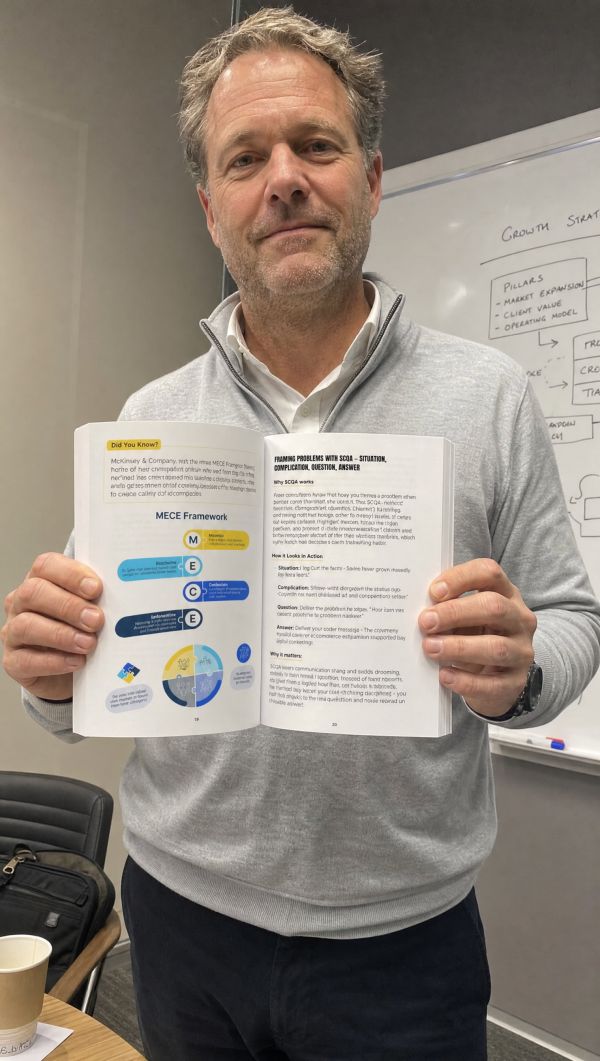
Consulting Management Explained, open to the SCQA and MECE chapter, next to a worked issue tree.
Five real business cases show what can happen when companies start solving before they’ve asked the right question.
The Cost of Bad Decisions
$250 million
The estimated annual wage cost of ineffective decision-making at a typical Fortune 500 company, according to McKinsey research.
Companies don’t lose that time because managers refuse to make decisions.
They lose it while smart people analyze, debate, revisit and defend decisions that still don’t feel clear.
More experience can improve an answer.
More data can sharpen it.
Neither can rescue the wrong question.
The most expensive business mistakes rarely begin with an obviously bad idea.
They begin with a reasonable answer to a badly structured problem.
Revenue drops.
Sales blames lead quality.
Marketing blames pricing.
Operations blames delivery.
Finance points at costs.
Everyone in the room can make a reasonable case.
Until the problem is structured, nobody knows which case actually matters.
That’s the real job of a framework.
Not to think for you.
To stop the room from answering before it has agreed on the question.
Different problems demand different questions.
The Five Questions Consultants Ask Differently
The framework changes depending on what you’re actually trying to understand.
01
MECE
Have we broken down the whole problem – or only the part we noticed first?
02
KPI Trees
Which driver is actually moving the number?
03
80/20
Which few things matter enough to ignore the rest?
04
Value Chain
Where is value really being created – or destroyed?
05
Ansoff
What kind of growth bet are we actually making?
Framework 01 · Problem Structure
MECE – Before You Solve the Problem, Make Sure You’re Solving All of It
The MECE framework spread — mutually exclusive, collectively exhaustive.
See MECE worked through → Extra 10% off – code ADV10 appliedA retailer sees profits fall 25%.
Management has a theory almost immediately: the sales team is underperforming.
The proposed response?
Proposed Fix
$500,000
Ready to be spent before the real cause was isolated.
Then the numbers pointed somewhere else.
- Supplier costs had risen.
- Markdowns had doubled.
- Margins were deteriorating.
The first explanation wasn’t irrational.
It was incomplete.
MECE forces the team to map the problem before choosing a culprit.
Sales performance is one branch. Costs, pricing and markdowns are others.
Miss one, and you can be perfectly rigorous about the wrong slice of the business.
A rigorous answer to an incomplete problem is still the wrong answer.
Your company doesn’t need a 25% profit collapse for the same mistake to become expensive.
It happens every time a team starts building a solution before it has mapped the full problem.
Case example from Consulting Management Explained.
Framework 02 · Diagnosis
– 4.9%
That’s where Domino’s U.S. same-store sales landed in 2008.
KPI Trees – “Sales Are Down” Is Not a Diagnosis
The KPI Trees and Root Cause Analysis chapter, with a worked e-commerce example.
Follow the full KPI tree → Extra 10% off – code ADV10 appliedA KPI tells you where the symptom showed up.
Not what caused it.
A KPI Tree keeps asking one question: what sits underneath this number?
It keeps going until the team reaches a driver it can actually influence.
2008
– 4.9%
2010
+ 9.9%
The conversation changes from “Why are sales down?” to “Which driver moved?”
A KPI is an outcome. Not a diagnosis.
The Question Changes the Decision
Same Business Problem. Better Question.
| What the room says | What the framework asks |
|---|---|
| “Sales are down.” | Which driver changed? |
| “Marketing isn’t working.” | Is acquisition actually the bottleneck? |
| “We need to cut costs.” | Where is value leaking? |
| “We need to grow.” | Which type of growth? |
| “We have too many priorities.” | What deserves disproportionate attention? |
Framework 03 · Prioritization
Sometimes Strategy Isn’t Deciding What to Build. It’s Deciding What to Kill
One product line at 80% of revenue, four others splitting the rest.
See what to cut, and why → Extra 10% off – code ADV10 appliedWhen Steve Jobs returned to Apple in 1997, the company was losing money on a product line few customers could explain.
The response wasn’t a bigger roadmap. It was a shorter one.
70%
of Apple’s product roadmap was cut after Steve Jobs returned.
1997
–$1.045B
1998
+$309M
Jobs wasn’t filling out a Pareto worksheet.
If everything stays important, nothing was prioritized.
Most teams won’t face a billion-dollar turnaround. They face the smaller version every quarter – too many initiatives, too little focus, and no clear rule for what deserves attention.
The 80/20 lesson isn’t “cut 70%.”
It’s that strategic attention should never be distributed evenly by default.
Notice What None of These Frameworks Do
They don’t tell you:
- Raise prices.
- Cut headcount.
- Launch the product.
- Enter a new market.
They don’t give you an answer. They force a better question before the answer becomes expensive.
The value of a framework isn’t that it makes decisions for you.
It’s that it makes sloppy thinking harder.
Built for Work Beyond the Page
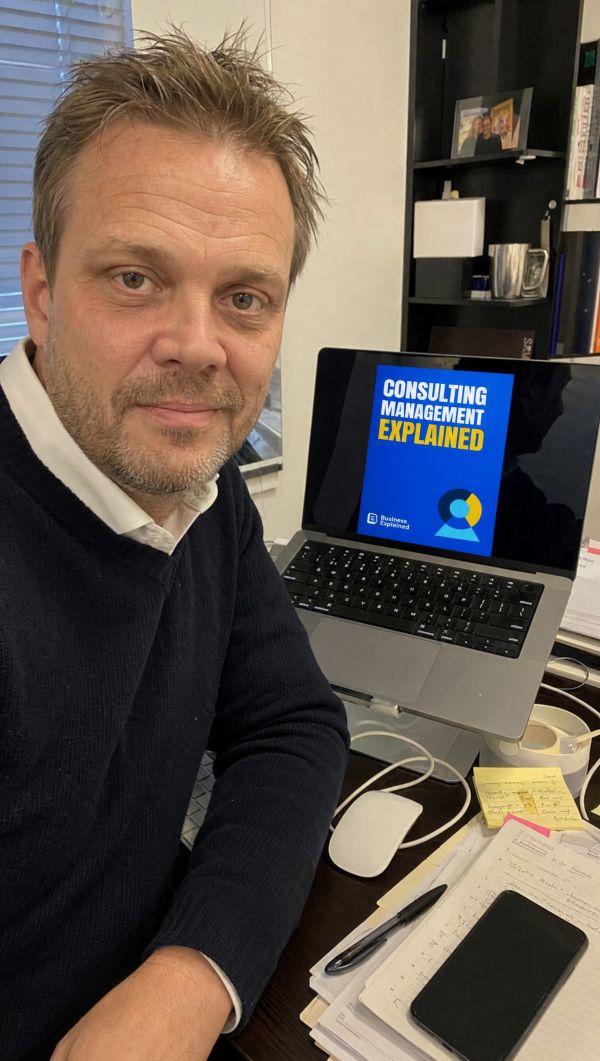
Real Business Explained readers with Consulting Management Explained in hand.






LIMITED-TIME OFFER
LOWEST PRICE EVER: Consulting Management EXPLAINED is currently at its lowest price in history. Lock in 40% OFF before the price goes back up.
Get it now at the lowest price we’ve ever offered
NOTE: This price is only available on our website – not on Amazon or anywhere else.
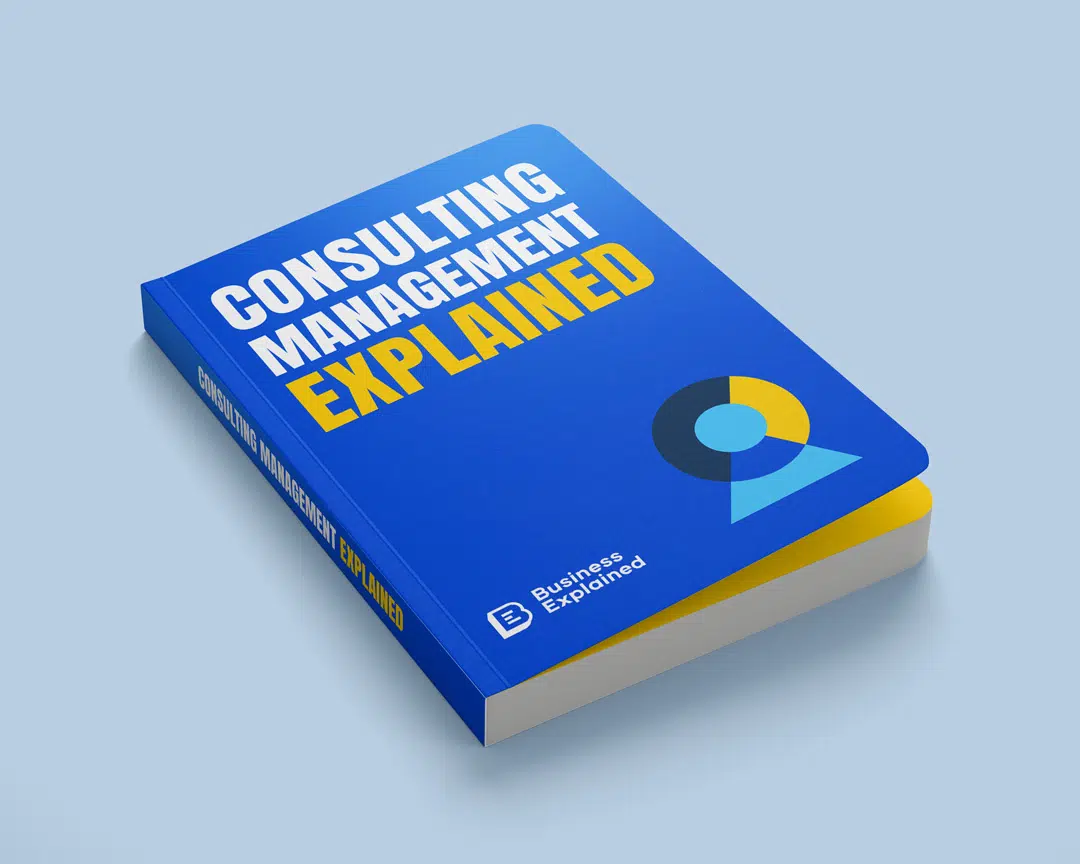
Consulting Management EXPLAINED
🔒 Secure Checkout
📧 Instant Delivery
💰 30-Day Money Back
Framework 04 · Value Creation
What If Growth Isn’t the Problem?
What if the business is creating revenue – and destroying value underneath it?
Value chain leverage points mapped activity by activity for an e-commerce retailer.
Map your own value chain → Extra 10% off – code ADV10 appliedBy 2004, LEGO was selling toys people loved and still losing money doing it. Too many components, too many product lines, too much cost buried in how the product was made and moved.
The turnaround attacked the economics, not the demand.
Cost Reduction
DKK 1.523 billion
2004 pre-tax
–DKK 1.688B
2005 pre-tax
+DKK 702M
Value Chain Analysis follows the money through the business instead of staring at the top-line result.
Suppliers→
Operations→
Distribution→
Customer
Where is value added?
Where is cost accumulating?
A business can have a sales problem. Or it can have a perfectly healthy sales engine sitting on top of broken economics.
Those two situations look identical on a revenue chart and require completely different decisions.
Revenue can grow while the business destroys value underneath it.
Framework 05 · Growth
Path A
Sell more of what already works?
Path B
Build something new?
Path C
Enter a new market?
Path D
Or change both at once?
Those sound like versions of the same growth decision.
They aren’t.
Ansoff – “Growth” Is Actually Four Different Bets
The Ansoff Matrix spread — penetration, product development, market development, diversification
Compare all four growth bets → Extra 10% off – code ADV10 appliedNetflix didn’t grow by doing one thing harder. It sold more subscriptions in a market it already had, moved the same service into new countries, and built a new product – streaming – for both.
12M → 20M
Subscriber growth during the period when streaming and international expansion accelerated.
| Existing offer | New offer | |
|---|---|---|
| Existing market | Market PenetrationSell more of what already works to the customers you already have.Lowest risk | Product DevelopmentNew offer, familiar market. Streaming to existing subscribers.Moderate risk |
| New market | Market DevelopmentSame offer, new territory. International expansion.Moderate risk | DiversificationNew offer and new market at once.Highest risk |
Risk rises the further you move from what you already know — existing offer, existing market.
Ansoff turns the vague instruction “grow” into four very different bets.
Same offer or new one? Same market or new one?
Each choice changes the risk.
The Real Consulting Skill Isn’t Knowing 50 Frameworks
It’s knowing which one to reach for.
- MECE – when the problem is messy
- KPI Trees – when a number moved
- 80/20 – when everything feels important
- Value Chain – when the economics don’t add up
- Ansoff – when growth is the question
Those five frameworks solve five kinds of questions.
Real work rarely stops at five.
Consulting Management Explained goes further, with tools for communication, competition, prioritization, diagnosis and more:
- SCQA
- Porter’s Five Forces
- ICE Scoring
- Root Cause Analysis
- Weighted Scoring
- PESTLE
Where each problem lives
You Do Not Need to Remember Which Framework. You Need to Know Which Chapter.
“Revenue dropped and nobody can agree on why.”
→
KPI Trees and Root Cause Analysis
Part 3: Breaking Down Problems
“I have to present this to leadership without rambling.”
→
Framing Problems with SCQA
Part 1: Structuring Problems
“The problem is too messy to even know where to start.”
→
Critical Thinking and the MECE Principle
Part 1: Structuring Problems
“Everything on the roadmap feels equally important.”
→
Cost Analysis and the 80/20 Rule
Part 3: Breaking Down Problems
“Leadership wants growth. Nobody has said which kind.”
→
The Ansoff Matrix
Part 4: Crafting Solutions
“Too many projects, not enough budget to fund them.”
→
ICE Scoring and Weighted Scoring Models
Part 4: Crafting Solutions
“I cannot tell whether we can actually win in this market.”
→
Porter’s Five Forces and PESTLE
Part 2: Analyzing the Environment
“The team executes, but without any system behind it.”
→
Agile, Scrum and Kanban
Part 6: Managing Execution
What Changes When You Stop Guessing

Consulting Management Explained – 109 pages, 40+ frameworks, instant PDF download.
First
You know what question comes first.
Instead of collecting answers immediately, you structure what actually needs to be solved.
Then
You start recognizing the shape of the problem.
Diagnosis. Priority. Growth. Competition. Execution.
Eventually
You stop reaching for frameworks. You start thinking through them.
The structure becomes part of how you approach the problem.
Knowing the Name Is Easy. Knowing the Move Is the Skill
Knowing the name
Knowing the move
“I’ve heard of MECE.”
I can structure an ambiguous problem.
“I know the 80/20 rule.”
I can decide what not to work on.
“I’ve seen Ansoff.”
I can classify the growth risk we’re taking.
“I know KPI Trees.”
I can trace an outcome back to its driver.
How it compares
This
eBook
eBook
MBA
Programs
Programs
Online
Courses
Courses
Business
Books
Books
Free
Content
Content
Visual frameworks and diagrams
Actionable the same day
Covers the full consulting toolkit
Concise, no filler
Standalone chapters
Consultant-grade depth
Structured and organized
Affordable
Three Things to Know Before You Decide
Prior Framework Familiarity
Already know SWOT? Good.
The value is knowing when SWOT is the wrong tool – and what to reach for instead.
How the Book Is Meant to Be Used
This isn’t a novel to finish. It’s a reference to reopen.
Find the problem. Find the framework. Apply it.
Fit for More Experienced Professionals
If you already work in strategy, the value isn’t new vocabulary.
It’s having the right structure close at hand when the problem changes.
What Matters Is Whether It Holds Up in Real Work
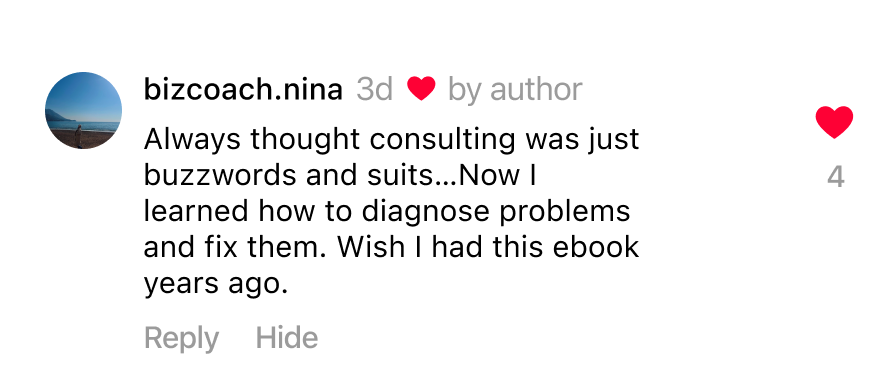
Real feedback from Business Explained readers – including Trustpilot reviews and comments shared across our channels.


4.93/5
Average rating
80,000+
Professionals served
190+
Countries
<0.4%
Refund rate
Fewer than 4 in every 1,000 buyers ask for their money back.
That number tells you more than any testimonial ever could.
Business Explained
Want the Frameworks Behind the Cases?

Consulting Management Explained
Consulting Management Explained brings together the frameworks, diagnostic tools and decision methods used to structure problems like these – with examples showing when and how to apply them.
- 109 Pages
- 40+ Frameworks & Tools
- Case Examples
- Instant PDF
Lowest price ever – 40% off
Get Your Copy – 40% OffThis price is only available on our website – not on Amazon or anywhere else. When the sale ends, the price goes back up.
Secure checkout
Instant delivery
30-day money back
 Lowest Price Ever!


 Your Products
 Refund Request
 FAQs
FAQs